Geography of Imghrane: Natural Setting and Ancient Human Settlement
An in-depth study of the geographic and natural setting of the Imghrane region, and the origins of its human, ethnic, and tribal composition through ancient accounts and rock engravings
Geography of Imghrane: Natural Setting and Ancient Human Settlement
Published: March 12, 2026
🗺️ Introduction
This article aims to provide an initial portrait of the geographic and natural setting of the Imghrane territory. It also offers a glimpse into the stages of its habitation and the origins of its human, ethnic, and tribal composition — drawn from ancient accounts and rock engravings found in the area. These testimonies indicate that the Imghrane region has known human settlement since antiquity, and that it also served as a vital corridor for numerous groups and tribes.
🏔️ The Antiquity of Settlement in the Atlas Regions
There is no doubt that the Atlas regions are among the oldest centers of human settlement in Morocco, thanks to the significant ecological and hydrological conditions they offered their inhabitants. Through various historical references, we can trace peoples and nations that reached the High Atlas region via mountain passes.
Ancient Peoples According to Greek and Roman Sources
Greek and Roman writings record the names of peoples who settled the area between the southern Atlas and the Draa Valley (Darat), including:
- The Bavares (Broresians)
- The Salatians
- The Ethiopian Pharusians
- The Gaetulian Draeans
These sources describe them as settled pastoralists, indicating an organized pastoral life in these regions since ancient times.
🌍 Coexistence of Human Groups in the Draa Valley
The Account of Jacques Meunié
The French researcher Jacques Meunié references the coexistence of diverse human groups in the Draa Valley in ancient times:
- African elements who settled the valley
- White pastoral communities who lived alongside them
- Mixed-race populations (Khlassin) descended from the blending of Black and White groups
This ancient ethnic diversity reflects the region’s position as a civilizational meeting point between the northern Sahara and the southern Atlas.
The Kushite Account in “Tali’at al-Da’a”
Muhammad al-Makki al-Nasiri in his work “Tali’at al-Da’a” (The Dawn of the Da’a) speaks of Kushite origins that settled in the Draa Valley:
“It springs from Jabal Dern and its foot dates from the time of Kush son of Ham son of Noah […] Kush followed the religion of the Magi, and his army numbered forty thousand warriors. He dominated all the people of the Maghreb for three hundred years until the Christians overcame the Children of Israel.”
It is quite plausible that these Kushites were the ancestors of the Haratin (or Harthanians). This is the view of Leo Africanus (al-Hasan al-Wazzan), who traced the origins of Black Africans to the descendants of Kush son of Ham son of Noah, while considering White inhabitants to be of Semitic origin from Saba son of Hama son of Kush — thus affirming a shared ancestry between the two groups despite their different appearances.
🔬 Gattefossé’s Theory
The researcher Gattefossé, who had access to two manuscripts of “Tali’at al-Da’a,” identified a connection between the Ethiopian Kushites and the Haratin spread across Tafilalet, Dades, Draa, and various parts of Morocco.
Gattefossé concluded that these Kushites possessed:
- An ancient glory and widespread influence
- A geographic reach that extended beyond the Saharan borders to the north of the Atlas Mountains
- A civilizational impact still visible in the demographic composition of the region

🪨 Archaeological Evidence: Rock Engravings
Regardless of the various accounts, archaeological sites in the Upper Draa and Tizi n’Tirist at Jabal Rat provide evidence of peoples passing through or settling in the Haskourra territory.
The Tizi n’Tirist Panels
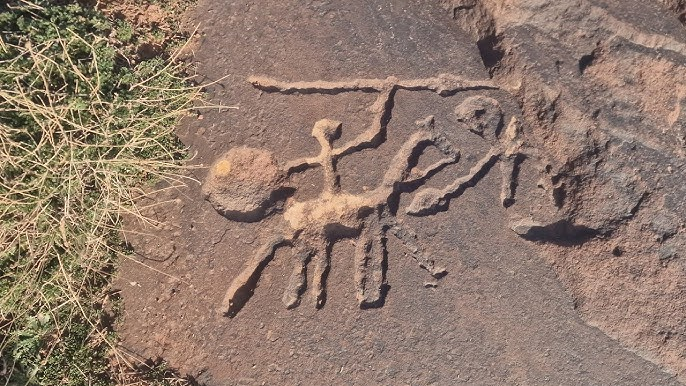
A significant number of rock panels document rich historical scenes:
“They consist primarily of engravings depicting horsemen armed with round shields, engaged in warfare with foot soldiers, or in hunting and racing scenes.”
Scholars’ Interpretations
| Scholar | Interpretation |
|---|---|
| Glory | Linked the engravings at the foot of Jabal Rat to Berber raiders who chose Tizi n’Tirist (at an altitude of 2,500m), near passes connecting the Sahara to the interior, to commemorate a battle they fought — and won — for grazing lands |
| Simoneau | Attributed the drawings to warrior-pastoralists who took refuge in the mountains during severe Saharan droughts between 2500 and 1200 BCE |
Both interpretations indicate that the region served as a strategic corridor between the Sahara and the interior, attracting human groups in search of pastures and water resources.
📜 Ibn Khaldun’s Description of the High Atlas
Ibn Khaldun describes the High Atlas Mountains (Adrar n Dern) in his time, highlighting their natural wealth and pastoral lands that made their tribes self-sufficient:
“Their territory sufficed them from all other regions of the world, so merchants traveled to them from all horizons and people from all provinces and cities frequented them.”
This description confirms the economic and geographic importance of the region as a center of commercial and human attraction.
⚔️ Haskourra: The Great Tribal Alliance of the Medieval Period
During the medieval period, a major tribal alliance that featured prominently in the events of this era settled in the Imghrane territory: Haskourra. Its territories lay between:
- The Masmuda bloc to the west
- The Sanhaja bloc to the east
Imghrane was one of the tribes under its banner. Like other tribal names — Hargha (Arghen) and Hazmira (Azmern) — the name Haskourra reveals, as one researcher has argued, the influence of Hebrew-Jewish scribes who used the letter “Ha” as a definite article in place of “Al.”
The Origin of the Name Haskourra
The word derives from Iskurn (plural of Askur), meaning partridge, and is a name for the people rather than their homeland. This raises questions about the meaning of the name Imghrane itself — a topic we explored in detail in our previous article: The Origins of the Name Imghrane: Between Oral Traditions and History.
📊 Summary of Historical Evidence
| Period | Evidence | Significance |
|---|---|---|
| Prehistory | Rock engravings at Tizi n’Tirist | Settlement of pastoralists and warriors (2500–1200 BCE) |
| Classical Antiquity | Greek and Roman writings | Settled pastoral peoples (Bavares, Gaetulians…) |
| Deep Antiquity | “Tali’at al-Da’a” account | Kushite settlement and ethnic diversity |
| Medieval Period | Islamic historical sources | Haskourra tribal alliance and Imghrane as a sub-tribe |
| Ibn Khaldun’s Era | Diwan al-Mubtada’ wal-Khabar | Natural wealth and commercial attractiveness |
🌿 Conclusion
The historical and archaeological evidence reveals that the Imghrane territory was far from an isolated mountain region. Rather, it was a vital corridor and a center of human attraction since the most ancient times. Diverse peoples and nations succeeded one another here — from the ancient Kushites to warrior Berber tribes, passing through settled pastoralists who documented their presence through rock engravings.
The distinctive geographic position of Imghrane — between the Sahara and the interior, between the Masmuda and Sanhaja blocs — made it a unique civilizational meeting point. This is reflected in the richness of its cultural heritage and the diversity of its human composition to this day.
📚 Sources and References
Abdelbasset Amkar, Aspects of the History of the Imghrane Confederation During the 19th Century, Master’s thesis, Department of History and Civilization, supervised by Dr. Mustapha El Kadiri, Academic Year 2023–2024.
Key references cited in the research:
- Akrir (Abdelaziz), Draa’s Ancient Commercial Role, in: Proceedings of the Draa Valley Symposium, Faculty of Letters and Human Sciences, Agadir, 1992, pp. 27–37.
- Al-Brinsi (Abdellatif), The Draa Valley and Draa Tribes in Ancient Sources, in: Proceedings of the Draa Valley Symposium, 1992, pp. 19–25.
- Meunié (Jacques), Le Maroc Saharien des origines au XVIe siècle, Tome I, Paris, Librairie C. Klincksieck, 1982, pp. 159–178.
- Al-Nasiri (Muhammad al-Makki), Tali’at al-Da’a fi Tarikh Wadi Dar’a, manuscript.
- Al-Wazzan (al-Hasan / Leo Africanus), Description of Africa, translated by Hajji Muhammad and Muhammad al-Akhdar, 2nd edition, 1983.
- Al-Tawfiq (Ahmad), Moroccan Society in the 19th Century (Inoultan 1850–1912).
- Al-Qabli Muhammad (ed.), History of Morocco: Update and Synthesis, Rabat, Royal Institute for Research in the History of Morocco, Okad Publications, 2nd ed., 2012.
- Ibn Khaldun (Abderrahman), Diwan al-Mubtada’ wal-Khabar, Vol. 6.
This article is the second in a series on the history of the Imghrane confederation. Also read: The Origins of the Name Imghrane: Between Oral Traditions and History