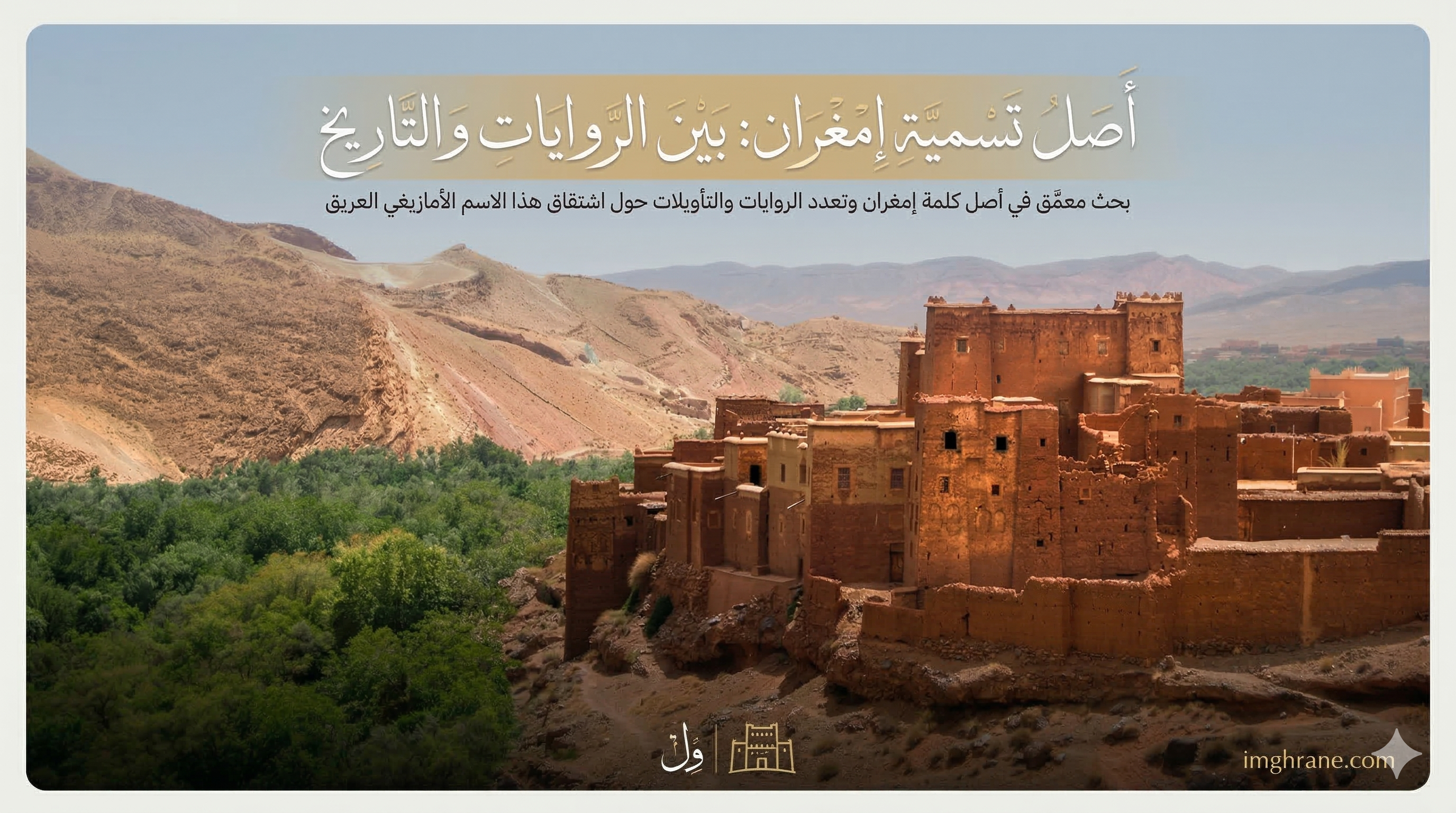
The Origins of the Name Imghrane: Between Oral Traditions and History
An in-depth exploration of the origins of the word Imghrane and the multiple theories and interpretations surrounding this ancient Amazigh name
The Origins of the Name Imghrane: Between Oral Traditions and History
Published: March 11, 2026
🔍 The Naming Puzzle
The very first challenge that confronts any researcher attempting to chronicle the history of the Imghrane confederation is the question of the name itself. This stems from the multiplicity of oral traditions, interpretations, and etymological derivations surrounding the origin of the word. The mystery deepens further when we consider whether the name originally referred to the geographic territory or to the human population that settled it — and whether it was self-given or bestowed upon them by others.
Note: We use the term “confederation” to denote the tribal grouping formed around the Imghrane tribe, which took its name. This confederation is believed to have been established after the dissolution of the Haskourra tribal alliance in the post-Marinid period. Before that, Imghrane existed as a smaller tribe and sub-group within Haskourra.
📖 The Different Theories
1. Imgharn — The Elders and Notables
Some traditions trace the meaning of Imghrane to Imgharn (plural of Amghar), meaning the elder, notable, or tribal chief. This interpretation points to a type of social and political organization known as the chieftaincy system (nizam al-mashyakha).
While the confederation did indeed feature this kind of local governance for public affairs, it was by no means unique to them among Amazigh tribes. This makes the interpretation too broad to serve as a precise historical explanation.
2. Imrghan — The Land of Salt Mines
Some local stories trace the word back to Imrghan, a name related to Amaraghh or Tamaraght, referring to lands containing rock salt.
“The tribe’s territory has contained numerous salt mines since ancient times, and its inhabitants were known as salt merchants and distributors among many southern tribes (Todgha, Ait Atta, Draa…)” — Mohamed Oujamaa, Ma’lamat al-Maghrib
Based on this, it is hypothesized that the word may have been distorted over time into Imghrane, though there is no definitive evidence to confirm this.
3. Igher — The Learned and the Readers
Another theory derives the name from the Amazigh verb igher, meaning: to know, to read. Under this interpretation, Imghrane would mean “the learned ones” or “the readers.” This is the etymology favored by Professor Mohamed Oujamaa, based on:
- Haskourra’s educational role in spreading Almohad teachings
- The abundance of scholars (fuqaha) who trained entire generations of Quran memorizers in the region
- The Friday sermon which until recently included the phrase “O God, grant victory to the armies of Muslims and the soldiers of the Almohads” — a formula dating back to the early Almohad period
- Islamic educational texts translated into the Amazigh Masmudi dialect and preserved in collective memory
However, this interpretation is weakened by the fact that the Haskourra’s primary role within the Almohad political organization was essentially military — rushing to battle in support of the Almohads. The medieval chronicler Al-Baydhaq refers to these duties by saying that “Haskourra al-Qibla are mazwarans” — meaning war leaders.
4. Igher — The Invited Ones / People of Hospitality ⭐
The most favored and widely circulated interpretation in the region derives the word from the same verb igher, but with a different meaning: to call, to invite. Under this etymology, Imghrane means “the invited ones.”
This is why the wedding celebration is called Tamghra — as it is an occasion to gather the invited guests to celebrate with the family. The singular form of the invitee is Imghri (and Tamghrit for a woman), a term still used to describe someone who originates from the region.
Oral tradition confirms that the inhabitants were accustomed to calling upon and inviting one another (dtmghouroun kradas n), and this behavior is clearly visible in Imghrane society through the celebrated quality of hospitality.
Thus, the most likely meaning of Imghrane is “Imdyafn” — the People of Hospitality.
❌ Ruling Out a Connection to the Zenati Maghrawas
Any connection between Imghrane and the Zenati Maghrawa tribe is ruled out, as evidenced by differences in language and culture. While the Maghrawa — princes of the Banu Midrar in Sijilmasa — may have extended toward the Imghrane territory to control Saharan trade routes, this does not necessarily imply kinship or blood ties between the two groups.
📋 Summary of Theories
| Theory | Derivation | Meaning | Assessment |
|---|---|---|---|
| Imgharn | Amghar (elder) | Elders and notables | Weak — too broad |
| Imrghan | Amaraghh (rock salt) | Land of salt mines | Possible — no evidence |
| Igher (to know) | Igher = to know, read | The learned ones | Strong but not favored |
| Igher (to invite) | Igher = to call, invite | The invited / People of Hospitality | Most likely and widely accepted |
🗺️ Current Administrative Division
The population of the Imghrane region is currently distributed across two rural communes:
- Toundoute
- Imi N’Oulaoune
Previously, there were three communes including Ghassat, before the Ait Zekri tribes were attached to the commune of Ighil N’Imkoun after having previously belonged to Toundoute.
📚 Source
Abdelbasset Amkar, Aspects of the History of the Imghrane Confederation during the 19th Century, Master’s thesis, Department of History and Civilization, Master’s program: History of Morocco — State, Systems and Society from Ancient History to Contemporary Times, supervised by Dr. Mustapha El Kadiri, Academic year 2023-2024.
Additional references cited in the research:
- Ibn Khaldun (Abderrahman), Kitab al-‘Ibar, vol. 6
- Mohamed Oujamaa, Imghrane, in Ma’lamat al-Maghrib, vol. 3
- Ahmed Houzali, Haskourra, Ma’lamat al-Maghrib, vol. 22
- Al-Baydhaq (Abu Bakr al-Sanhaji), Al-Muqtabas min Kitab al-Ansab fi Ma’rifat al-Ashab